GETTING COMPLIMENTED FOR SAYING HELLO
The nihongo jouzu compliment lands the second any foreigner produces a single Japanese sound. Here is what thirteen years of being told your Japanese is very good after saying 'konnichiwa' actually does to a person.
 By The Angry Gaijin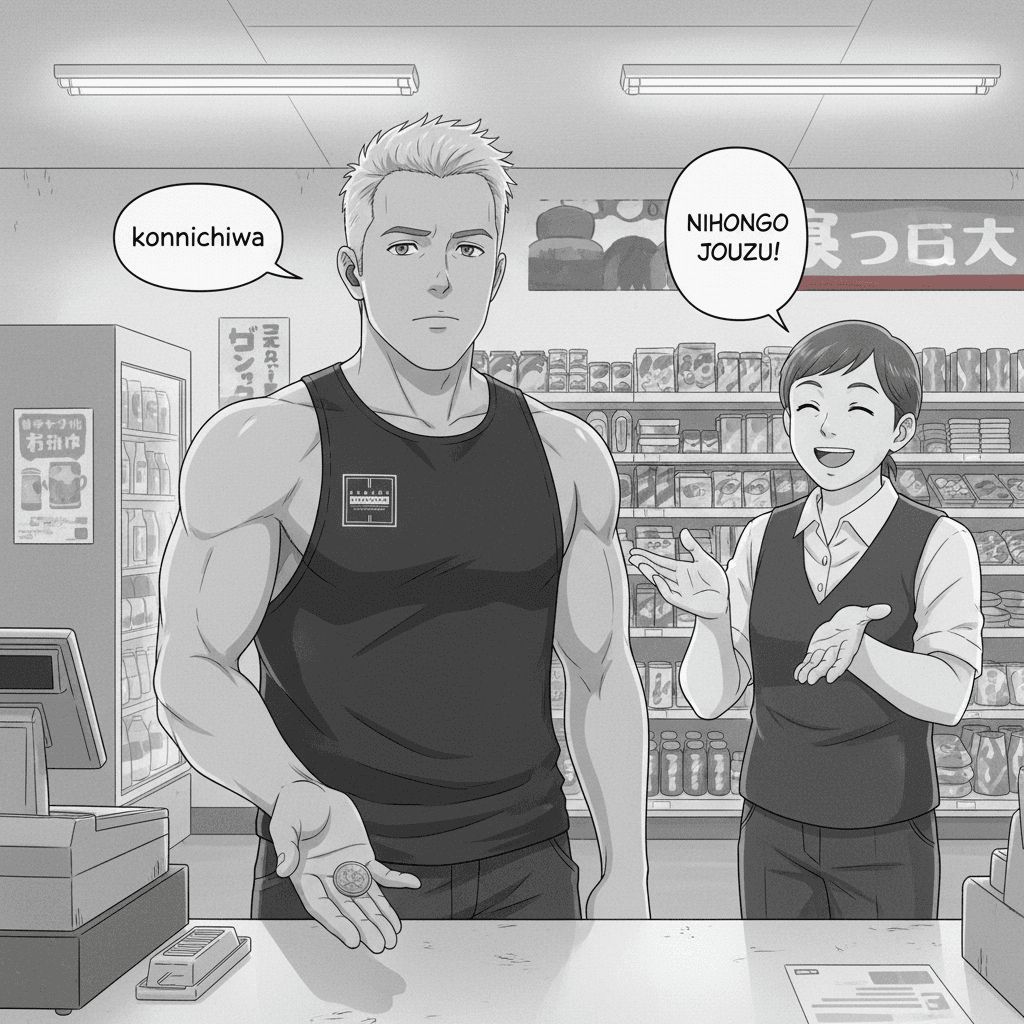
I said konnichiwa. One word, and a renowned greeting. A single, four-syllable greeting that a toddler masters before it can walk, and the lass behind the counter looked at me with the warm, beaming pride of a parent watching a child take its first steps and said it. Nihongo jouzu desu ne. Your Japanese is very good. I had said one fucking word. The compliment of nihongo jouzu arrived before the sound had fully left my mouth, fully formed, pre-loaded, fired off like an airbag. It is not a response. It is a reflex. And after thirteen years in this country I have come to understand it the way you understand a recurring dream where you cannot find the exit.
Let me walk you through the stages, because there are stages, and anyone who has done their time here knows them like the bloody catechism.
Year one, you are delighted. Somebody said you were good at something. You float home. You tell your mum on the phone. Year three, the gloss is off and it has curdled into a mild irritation, a little itch, because you have noticed it happens regardless of what you say or how well you say it. Year seven is when the hollow feeling arrives. A specific one. The realisation that the compliment is not measuring your Japanese at all, because it was deployed identically when you grunted konnichiwa and when you delivered a clean, grammatical, keigo-laced sentence about the discrepancy on your residence tax. Same words. Same smile. Same fucking pat on the head.
And then year thirteen, where I currently reside, rotting. Where the urge that rises in me is to respond in the kind of fluent, structurally vicious Japanese that takes a decade to build, and to say, slowly, with eye contact: this compliment has not aged well, has it.
Why nihongo jouzu is not actually about your Japanese
Here is the bit that makes me want to put my head through a meat grinder. It is not malice. I want to be completely clear about that, because some tosser in the comments will accuse me of taking it personally. It is not personal. That is the entire problem. It is a script. It is tatemae with the safety catch off, a social lubricant squirted automatically the instant a foreign face produces a Japanese phoneme, and the fact that it is automatic is precisely what guts it. A real compliment requires that someone assessed you and found you good. This requires only that you exist and made a noise.
Which means that for thirteen years, every time I open my mouth in this country, the machine has assessed me, instantly, and the assessment is always the same: foreign object, emitting sounds, performing surprisingly well for a foreign object. The bar is on the floor. The bar is, in fact, buried. The bar is did the gaijin make a sound. And I cleared it. Congratulations to me. For fuck's sake.
The galling thing, the genuinely galling thing, is that there is no version of this you can win. Speak badly and you get nihongo jouzu as kindness. Speak well and you get nihongo jouzu as a polite full stop, a little verbal hand on the chest that says and that's quite enough integration for one day, thank you. It is a door that smiles at you while remaining shut. Thirteen years of pushing on a door that smiles.
The thing I can never say back
I know exactly what I want to do. I want to turn to the next person who says it after I order a coffee and reply, in the register I have spent a decade and several thousand pounds of lessons constructing, that I have lived here longer than their newest colleague has been alive, that I file my own taxes, that I argued with NTT in this language and won, and that perhaps, just perhaps, we could retire the participation trophy.
But I won't. Because that breaks the script, and you do not break the script, and the muppet who breaks the script becomes the angry foreigner, the cautionary tale, the bloke who couldn't take a compliment. So I smile. I say iie iie, mada mada desu. No no, I've a long way to go. Which is the correct, humble, scripted response. Thirteen years of humility about a language I dream in now.
Your Japanese is very good. Mate, I said “hello”, you cockwomble. Cheers though.
“The bar is on the floor. The bar is, in fact, buried. The bar is did the gaijin make a sound. And I cleared it. Congratulations to me.”
Nobody's raged yet. Set the tone.
You Survived This Article.
Congratulations. You are now contractually obligated to forward it to one other foreign resident who is having a worse week than you.
More Rage Where That Came From
All Rants →
SHOUGANAI: THE MAGIC WORD FOR PEOPLE WHO CAN'T BE ARSED
The Japanese shouganai meaning is supposed to be a graceful acceptance of the unchangeable. In practice it's the most elegant way ever invented to say 'I can't be arsed and you can't make me.'
RAJIO TAISO: THE STATE-SANCTIONED STRETCHING CULT NOBODY ASKED FOR
Rajio taiso, the nationwide morning radio calisthenics ritual, is not exercise. It is a compulsory group performance of belonging, broadcast at dawn to people who would rather be asleep.
THE SALARYMAN SNEEZE: 500 DECIBELS OF PURE DEFIANCE
In a country obsessed with silence and reading the room, the Japanese salaryman sneeze detonates like an artillery shell on the 7:42 Yamanote. Nobody flinches. Nobody comments. It is the loudest permitted sound in the quietest culture on Earth.
Comments
…