THE NOMIKAI YOU CANNOT LEAVE UNTIL THE BOSS DOES
The after-work drinking party in Japan is technically voluntary and functionally a hostage situation. It is Tuesday night, it is nearly eleven, and nobody is moving because the section chief still has beer in his glass.
 By The Angry Gaijin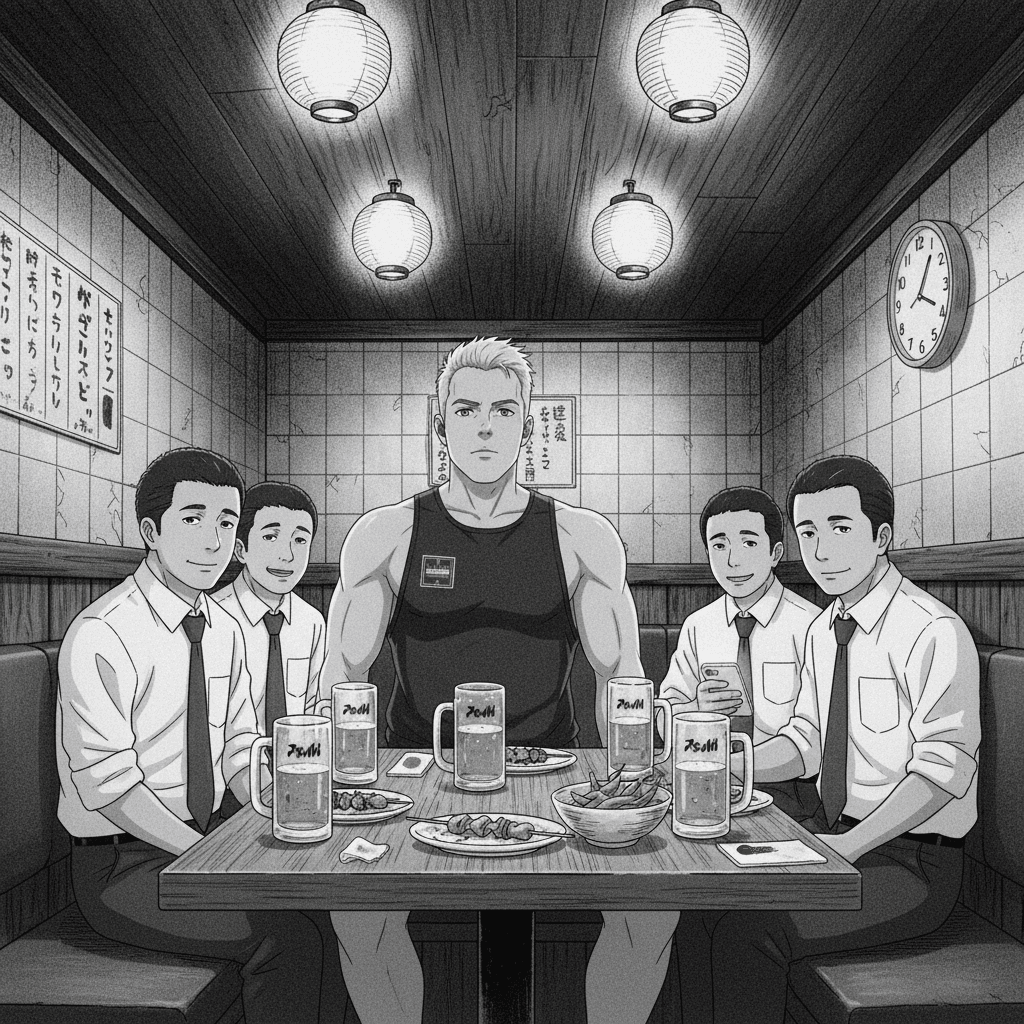
It is 10:47pm on a Tuesday in a Shinjuku izakaya, and every single person at this table wants to go home.
Not in the polite, performative way where someone murmurs soro soro and everyone laughs and stays for another round. I mean genuinely, biologically, desperately wants to go home. The woman across from me has been visibly asleep with her eyes open for the last twenty minutes. The bloke to my left is checking his phone under the table with the furtive concentration of a man defusing a bomb. I have drunk four glasses of Asahi I didn't want and eaten two skewers of something that I think was chicken liver, and I have smiled so continuously that my face has started to feel like a mask that was applied with industrial adhesive.
And yet. Nobody moves. Because Tanaka-kacho, the section chief, a man of fifty-three with the unshakeable calm of someone who has broken the will of every subordinate he has ever had, still has beer in his glass. Not much beer. Maybe three sips. But those three sips are, in the social physics of this particular situation, load-bearing. They are the keystone of the entire bloody evening. The moment that glass empties, someone will exhale, someone will say otsukaresama deshita, and twenty-three adults will stampede for the door like the building's on fire. Until then: we perform.
Why the nomikai is the purest expression of Japanese work culture
The nomikai, for those who've not had the pleasure, is the after-work drinking party that appears in your calendar as optional and functions as anything but. Skipping one is technically allowed. Skipping one is also, in the unspoken ledger that runs beneath every Japanese office, a career event. Not in the dramatic, HR-documented way. More in the soft, gradual, entirely deniable way where you stop being included in conversations, where your name doesn't come up when the interesting projects are discussed, where you become a person who is difficult to read, which in Japanese professional culture is roughly equivalent to being a person who is difficult to trust.
So you come. You all come. You sit in your designated seats (do not sit where you like, this is not a picnic), you pour for your seniors before yourself, you refuse the first pour with exactly the right level of theatrical reluctance before accepting it, and then you drink beer you may not want while talking about work in the register of not talking about work, and the entire performance is called leisure.
This is the bit that gets me. Not the obligation, frankly. Obligation I can handle. I've worked in British offices; I know what it is to stand in a car park in February eating a Greggs sausage roll because it's Janet's birthday and Janet has specifically requested we not make a fuss. The obligation, I understand. It's the laundering of it. The insistence that this is fun, voluntary, a chance to loosen up and bond as a team. The way that honne and tatemae are operating simultaneously in the same room, with everyone performing enjoyment for everyone else's benefit while everyone else is performing enjoyment right back at them, and the whole thing is a perfectly sealed circuit of collective pretending.
The specific torture of watching a man drink slowly
For fuck's sake, he's swirling it now. He's actually swirling the glass.
I have been in this country eleven years. I have done the late-night trains home, the morning-after performance of being fine, the careful calibration of how drunk to get (enough to seem warm and participatory, not so much that you do something that will be remembered forever and described only as that time). I have learned to read the room. I can do kuuki wo yomu with the best of them. And what I'm reading in this room, right now, is twenty-three people held hostage by one man's inability to finish a drink at a normal human pace.
Tanaka-kacho is not a villain. That's the thing. He's probably quite tired as well. He might even be aware, on some level, that everyone is waiting. He has almost certainly done this himself, sat at this same table fifteen years ago, watching his own section chief, performing the same vigil. This is simply how the thing works. The ritual eats itself and keeps going.
The glass is nearly empty now. People are shifting fractionally. Someone has retrieved their jacket from the back of their chair with the slow casualness of a man who has been planning this move since nine o'clock.
Tanaka-kacho orders another beer.
Right. I'm having a cigarette I don't smoke.
“The insistence that this is fun, voluntary, a chance to loosen up and bond as a team — that's the bit that gets me. Not the obligation. The laundering of it.”
Nobody's raged yet. Set the tone.
You Survived This Article.
Congratulations. You are now contractually obligated to forward it to one other foreign resident who is having a worse week than you.
More Rage Where That Came From
All Rants →
THE MEETING TO SCHEDULE THE MEETING ABOUT THE MEETING
A forensic autopsy of Japanese corporate meeting culture, the kaigi where no decision is ever made, the ringi that circulates for three weeks, and the corridor whisper that does all the actual work.
Comments
…