TWO HOURS IN A CLINIC TO BE TOLD I HAVE THE COLD I WALKED IN WITH
Booking a Japanese doctor's appointment is impossible. Instead you take a paper ticket, lose a morning to the waiting room lottery, and pay across three separate queues to learn you have the cold you described on arrival.
 By The Angry Gaijin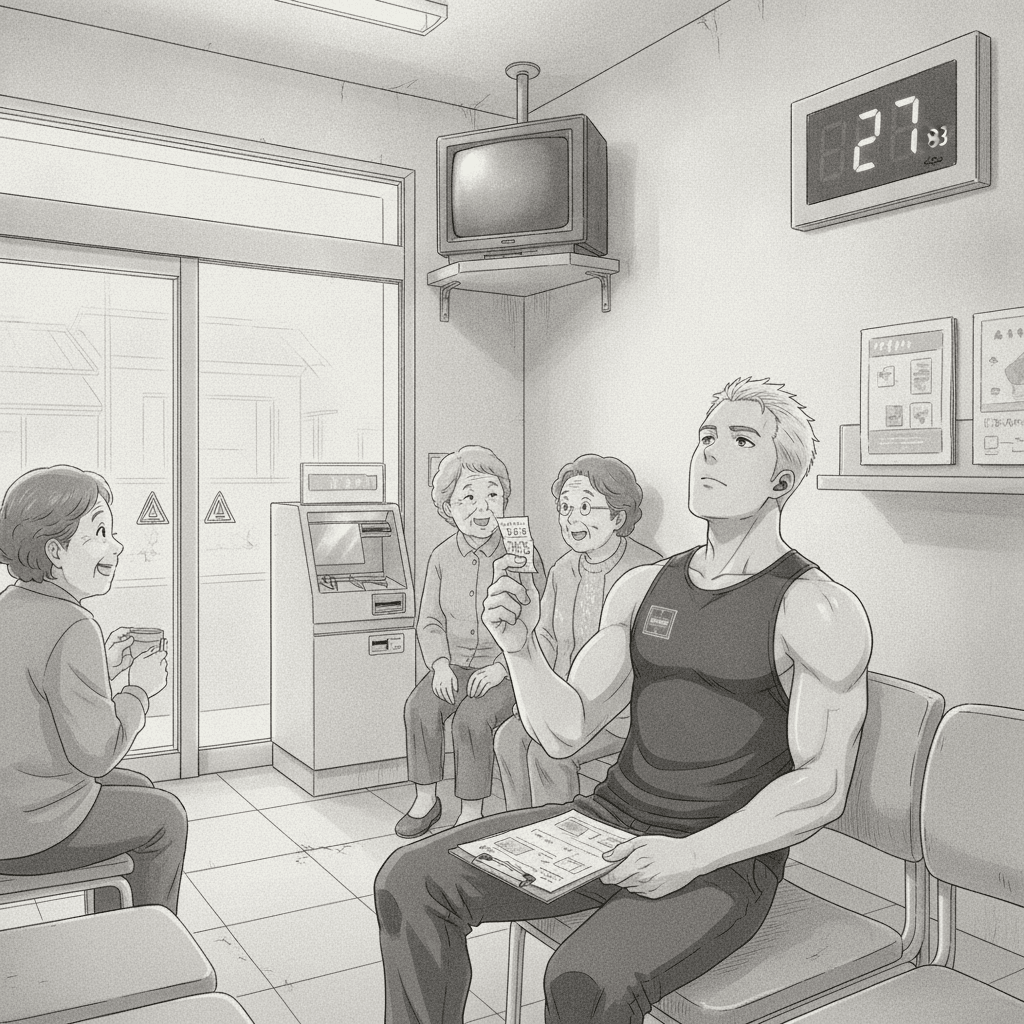
I have lost an entire morning of my one finite life to a Japanese clinic, and at the end of it a man in a white coat looked at me for four minutes and confirmed, with the gravity of a coroner, that I have a cold. The cold I walked in describing. The cold I told the receptionist about. The cold I had written down, in Japanese, on the form I have now filled in eleven fucking times at this exact clinic because nothing, anywhere in this building, has been digitised since the Showa era.
Let me explain how booking a Japanese doctor's appointment works, for the uninitiated. It doesn't. You cannot book. The concept is foreign to them. You arrive, ill, at a time of their choosing, and you approach The Machine.
The ticket machine. A beige sovereign nation unto itself, dispensing little paper numbers like it's deciding the fate of the realm. You take number 34. The board says they are currently seeing number 9. It is 9:05am. You understand, in that moment, that you have made a terrible mistake, because the waiting room is already a sea of obaasan who arrived at 6am not because they are ill but because this is where their friends are. The clinic is their social club. You are an intruder at their morning coffee, except there's no coffee, only the smell of antiseptic and a telly playing NHK at a volume designed for the deceased.
Why you fill in the same bloody form every single time
Here is the genuinely insulting bit. They have my details. They have had my details for years. I am in their system, such as it is, which appears to be a metal cabinet and the long-term memory of a woman who retired in 2019. And yet every single visit, without fail, I am handed a clipboard and asked to write my name, my address, my date of birth, my symptoms, and to tick the same fourteen boxes about whether I am currently pregnant. I am not. I have never been. I have told them this, in writing, eleven times. For fuck's sake.
Then comes the theatre. They sit you down and strap on the blood-pressure cuff, that solemn ritual performed regardless of why you came, as though the cure for a sniffle is hidden somewhere in your systolic reading. It inflates. It deflates. A number is recorded that nobody will ever look at again. This is not medicine. This is a performance of medicine, staged daily by people in immaculate uniforms for an audience of the mildly unwell.
The consultation itself lasts four minutes. You describe the cold. He nods. He looks vaguely into your throat with the enthusiasm of a man checking a parcel he didn't order. He says the Japanese for "it's a cold", which I already knew, which I had said, which was the entire premise of my visit, and he prescribes you something with the active ingredient of a Murray mint. Magnificent. Truly the work of a sovereign nation's finest minds.
And then, the queues. Plural.
You would think it ends there. You absolute mug. It does not end there. You then join the second queue, the paying queue, where the same receptionist who handed you the clipboard now processes your payment with a slowness that suggests she is also personally minting the coins. Twelve minutes. For a transaction that is, in any functioning country, a tap of a card.
Then, holding your sacred prescription like a relic, you are sent across the road. Across the bloody road. To a separate dispensing pharmacy, a wholly distinct kingdom, where you take a third ticket, fill in a fourth form, the same form, your name, your address, are you pregnant, and wait again while a pharmacist in a different immaculate uniform reads the doctor's note and hands you the mint.
Three queues. Two buildings. One form filled in repeatedly by a grown adult. Four minutes of actual medicine sandwiched inside two hours of choreographed administrative theatre, performed by lovely, polite, smiling people who are absolutely committed to wasting your entire morning on principle.
I walked in with a cold. I walked out, two hours later, with a cold and a piece of paper confirming the cold. The tossers. The clinic, as an institution, can do one.
“This is not medicine. This is a performance of medicine, staged daily by people in immaculate uniforms for an audience of the mildly unwell.”
Nobody's raged yet. Set the tone.
You Survived This Article.
Congratulations. You are now contractually obligated to forward it to one other foreign resident who is having a worse week than you.
More Rage Where That Came From
All Rants →
JUUMINHYO: THE 300-YEN TICKET THAT PROVES YOU EXIST
The juuminhyo, Japan's residential certificate, is required for nearly every adult transaction, costs ¥300, and expires almost the moment it's printed. A field report on proving you exist in Japan, three days too late.
Comments
…